
The End of Duration of Status: What F-1 Students Need to Know Before September 15, 2026
Published July 2026 | F-1 Visa Policy Update | Lighthouse CPT Inc.
Summary
On July 17, 2026, the U.S. Department of Homeland Security published a final rule that ends Duration of Status (D/S) admissions for F-1 international students. The rule takes effect on September 15, 2026.
Under the new rule, F-1 students will be admitted for a fixed period which is up to four years, based on their program end date. Students who need more time must apply directly to USCIS for an Extension of Stay. The rule also prohibits graduate students from transferring schools mid-program and bars any F-1 student from pursuing a degree at the same or lower educational level as one already completed.
Key Facts
- Rule published: July 17, 2026
- Effective date: September 15, 2026
- Who is affected: All F-1 (and J and I) nonimmigrant students
- Key change: Duration of Status (D/S) replaced by a fixed admission period of up to 4 years
- New filing requirement: Extension of Stay (EOS) must be filed with USCIS if a student’s program extends beyond their I-94 date
- Grace period: Reduced from 60 to 30 days after program completion
Highlights
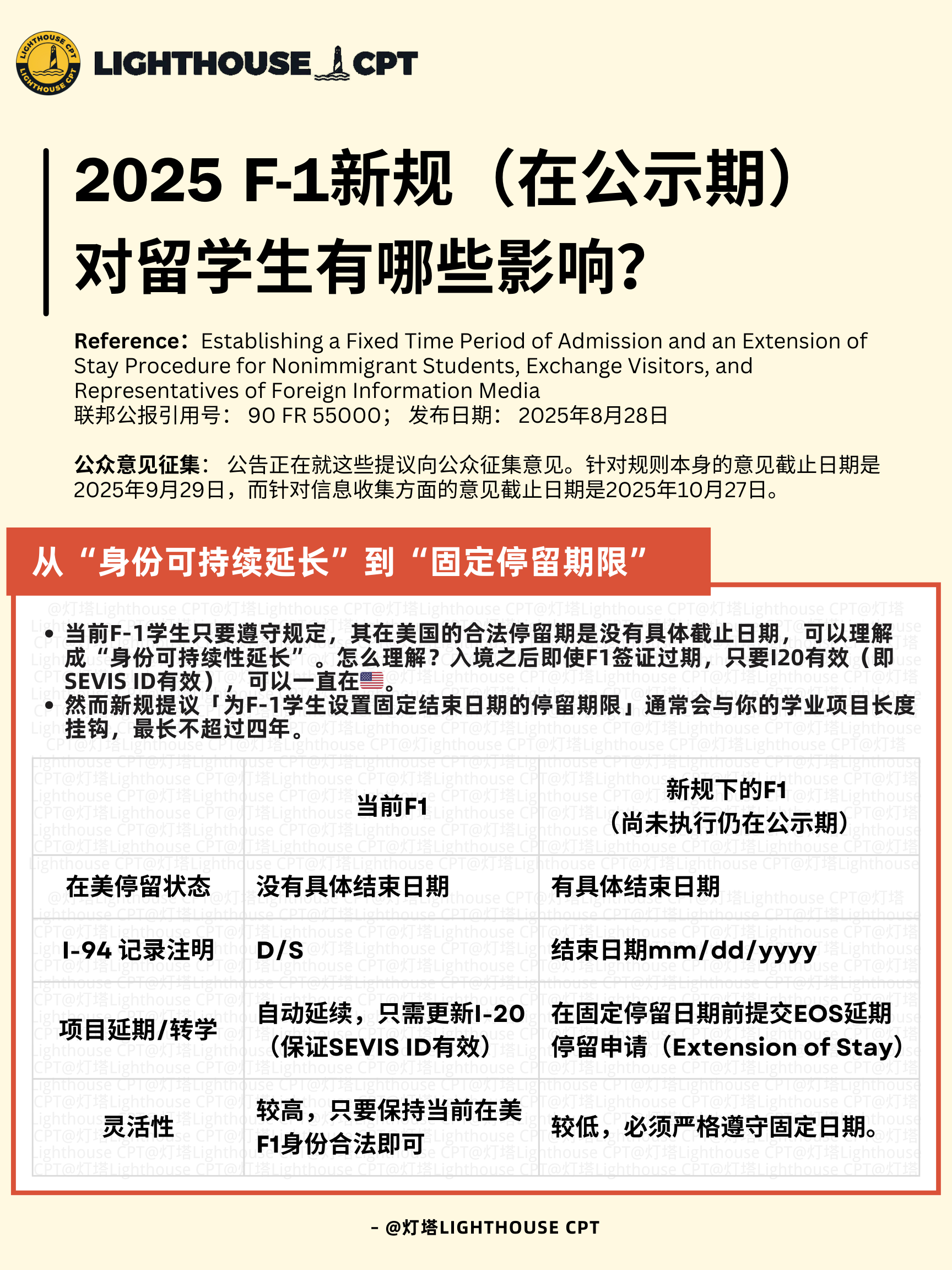
- D/S is gone. A specific expiration date now appears on your I-94. Every new F-1 admission will carry a fixed end date which is the program end date listed on the I-20 form Page 1, or up to a maximum of four years.
- Overstaying now immediately triggers unlawful presence. Under D/S, F-1 students were largely shielded from accruing unlawful presence unless a judge or immigration officer made a specific finding. That protection is gone. Miss your I-94 deadline without filing an EOS, and unlawful presence begins accruing the next day.
- Extensions are not automatic. You must apply. If a program runs beyond the I-94 expiration date, the student must file an Extension of Stay with USCIS before it.
- Graduate students cannot transfer schools. Once enrolled in a graduate program, F-1 students may not transfer to another institution. The only exception requires SEVP approval for extenuating circumstances. This restriction applies from the moment the rule takes effect.
- A completed Master’s degree closes the door to a second one. F-1 status now requires upward educational progression. Students who have already earned a Master’s degree cannot use F-1 status to pursue another Master’s.
- The post-completion window is half what it used to be. The grace period has been reduced to 30 days (down from 60) to depart or take action after completing a course of study or authorized practical training.
- OPT and STEM OPT applicants have a six-month buffer. During the first six months after the rule takes effect, students applying for post-completion OPT or STEM OPT employment authorization are temporarily exempt from the EOS filing requirement. This buffer expires around March 18, 2027.
Before and After: Key Rule Changes
| Topic | Before (D/S) | After (Effective Sept 15, 2026) |
|---|---|---|
| I-94 Admission | “D/S”: no specific expiration date | Fixed date based on program end, up to 4 years |
| Authorized Stay | Tied to maintaining student status | Tied to a specific calendar deadline |
| Overstay Consequence | Unlawful presence did not accrue unless a judge/officer made a specific finding | Unlawful presence accrues immediately upon overstay |
| Staying Beyond Program End | DSO updates I-20; student remains in status | Student must file Extension of Stay (EOS) with USCIS before I-94 expires |
| EOS Approval Authority | Not applicable | USCIS adjudicates |
| Graduate School Transfer | Allowed with DSO coordination | Prohibited mid-program; SEVP approval required for extenuating circumstances |
| Second Master’s Degree | Permitted under F-1 | Prohibited. F-1 students must progress to a higher educational level only when the rule takes effect. |
| Changing Educational Objective (Graduate) | Allowed during enrollment | Prohibited at any point during a graduate program |
| Undergraduate Transfer | Allowed at any time with DSO coordination | Must complete first academic year at initial school before transferring |
| Post-Completion Grace Period | 60 days after program or OPT end | 30 days after program or OPT end |
| OPT / STEM OPT Filing | No EOS requirement | 6-month buffer from EOS requirement before March 18, 2027 |
| ESL Programs | No aggregate cap defined under D/S framework | Maximum 24 months aggregate, including breaks and vacation |
| Program Extension Grounds | DSO-managed; academic probation and delays broadly accommodated | USCIS adjudicates. Students must file an EOS before their I-94 expires. |
Q&A
Q1: My I-94 currently says ‘D/S.’ What happens to me after September 15? DHS has transition provisions for current D/S students. However, the protection that prevented unlawful presence from accruing under D/S will no longer apply once the rule takes effect. Confirm your program end date now and understand when EOS obligations may apply to you.
- If you are currently on OPT/ STEM OPT with I94 on D/S, your expired date in the U.S is your EAD End Date. When you finish the OPT, the grace period will still be 60 Days.
- For current F-1 students, if you need to start your OPT/ STEM OPT extension application from Sep 15, 2026 to Mar 18, 2027, you don’t need to file EOS as well. If you need to submit the OPT/ STEM OPT application after Mar 18, 2027, even if your I94 is D/S, you still need to file EOS.
Q2: What is an Extension of Stay and how do I file one? An Extension of Stay (EOS) is a formal application submitted to USCIS that requests continued F-1 status beyond the date on your I-94. It must be filed before your I-94 expires. It is not automatic and is separate from your DSO’s program extension.
Q3: If my EOS application is still pending after my I-94 expires, am I out of status? No. If you filed a timely EOS application, before your I-94 expired, you are authorized to continue your full course of study while the application is under review. Employment authorization also continues automatically for up to 240 days.
Q4: I am applying for OPT. Does this rule affect my application? For the first six months after the rule takes effect. From Sep 15, 2026 to Mar. 18, 2027, students applying for post-completion OPT or STEM OPT Extension are temporarily exempt from the EOS filing requirement. Outside that window, standard EOS rules apply. More details of EOS will be waiting for USCIS guidance.
Q5: My program takes five years to complete. What do I need to do? You will be admitted for a maximum of four years. Before your I-94 expires, you must file an Extension of Stay with USCIS to cover the remaining program period. Your DSO will need to issue an updated I-20 recommending the extension, but the final decision rests with USCIS.
- For current students in the U.S and I-94 with D/S, if your program takes more than five years, the expired date is no longer than Nov. 14, 2030 including 60 days grace period.
Q6: Where should I go for guidance specific to my situation?Your school’s Designated School Official (DSO) is your first point of contact.
Q7: What is EOS? How much does EOS Cost? Is Premium Processing available? How long does standard processing take?
- EOS meaning Extension of Stay which is represented Form I-539
- Base Filing Fee: $420 (if filed online) or $470 (if filed on paper).
- For currently, Premium Processing is NOT available for Form I-539 extensions for F-1/F-2 students.
- Typically 3 to 6+ months, depending on the USCIS Service Center handling the case and the specific visa category.
Q7: Can I travel outside the U.S while my EOS is pending? No. Leaving the United State while EOS is pending will cause USCIS to consider the application abandoned, resulting is an automatic denial of change of extension request.
Disclaimer
This article is produced by Lighthouse CPT Inc. for informational purposes only. It does not constitute legal advice and should not be relied upon as a substitute for professional immigration counsel.
Lighthouse CPT Inc. is an education and recruiting consulting firm. We do not provide immigration legal services.
Every student’s immigration situation is unique. If you have questions about how this rule applies to your specific circumstances, please contact your school’s Designated School Official (DSO) or consult a licensed immigration attorney.